Ricoh and ETRIA launch “Circular New,” a manufacturing concept, turning resource circulation into competitive advantage
- Reduces newly sourced material use from about 76% to as low as 21% with product carbon footprint expected to drop by up to 25%
- Delivers latest-generation models with consistent quality, functionality and warranty, while utilising components recovered from the market
- Strengthens supply chain resilience and manufacturing competitiveness through localised production
TOKYO, October 14, 2026 — Ricoh Company, Ltd. and ETRIA CO., LTD. today announced “Circular New,” a manufacturing concept that transforms products already used in the market into assets for future production, turning resource circulation into new product value and manufacturing competitiveness. As the first application, the concept will be introduced to Ricoh’s A3 black and white multifunction printers (MFPs), with localised production and launch scheduled in Japan and Europe in the first half of 2027.
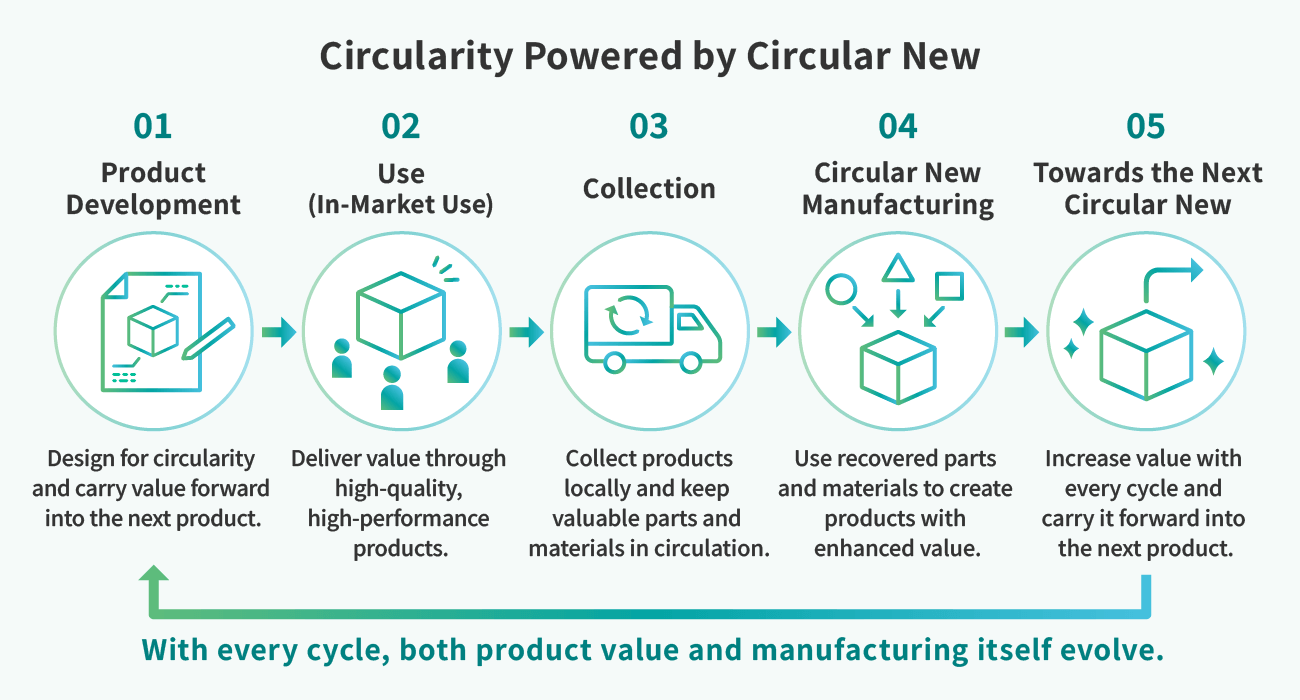
Compared with conventional centralised production at major manufacturing sites, localised circular production close to consumption markets is designed to reduce the proportion of newly sourced materials used from approximately 76% to as low as approximately 21%1. Customers will receive the same latest-generation models, with consistent quality, functionality and warranty, regardless of the production method.
Circular New integrates product planning, design, manufacturing, use, collection, and reuse into a single continuous loop, utilising products already in the market as assets to manufacture new products with added value. In addition to conventional centralised production, Ricoh and ETRIA will establish localised circular production in Japan and France to create a regional loop of resource and component reuse, further expanding circularity. Localised production can reduce the product carbon footprint by up to 25%2. This reduction is achieved by lowering the use of newly sourced materials and shortening transportation distances, while establishing a resilient supply framework to ensure reliable product delivery amid geopolitical risks, logistics disruptions and resource price volatility. Centrally manufactured and locally produced products will be offered within the same product lineup, delivering consistent product value regardless of manufacturing method or location.
Ricoh and ETRIA have long worked together to reduce newly sourced material use by incorporating recycled materials, such as recycled plastics and steel. Looking toward future circularity, ETRIA integrates design principles from the planning and development stages, including sharing frames and components across generations and models, extending component lifespans and designing structures for simple disassembly and replacement. Building on this design foundation, Circular New combines digital insights into product and component conditions with advanced sorting and quality assurance technologies. This allows Ricoh and ETRIA to go beyond using recycled materials and instead recover and reuse resources and components from existing products directly in the latest-generation models.
With Circular New, Ricoh and ETRIA aim to establish Evolving Circularity—moving beyond reducing environmental impact to continuously channel recovered resources and components into next-generation product value while advancing manufacturing itself.
In its Mid-Term Management Strategy ’26, announced in March 2026, Ricoh set a target of achieving a 30% engine market share for ETRIA by fiscal 2030. Circular New is one of the initiatives supporting this growth strategy, strengthening ETRIA’s manufacturing competitiveness through circular product design and localised production.
Katsunori Nakata, executive corporate officer and president of RICOH Digital Products Unit, Ricoh Company, Ltd., and CEO of ETRIA, said, “Circular New directly challenges the assumption that manufactured products must follow a linear lifecycle. Guided by our principle of aligning ESG with business growth, the Ricoh Group aims to reduce newly sourced material use to 60% by 2030 and 12% by 2050. Through this localised circular production model, we are committed to demonstrating that resource circulation can drive both customer value and manufacturing competitiveness.”
James Loginov, Director of ESG Governance at Ricoh Asia Pacific, said, "Customers and stakeholders increasingly expect sustainability to be measurable, not just promised. Circular New delivers on that. Cutting the proportion of newly sourced materials in a device from around 76% to as low as 21% is a significant, tangible result, and it comes without compromising the quality our customers rely on.
"Just as important to our customers is the fact that Circular New makes good business sense, building on the Comet Circle circular economy model that has guided Ricoh since 1994. Reusing materials reduces our dependence on new resources and helps create supply chains that are more resistant to sudden shocks and disruptions. Proof that responsible manufacturing practices and long-term growth can go hand in hand."
1 By weight, among newly manufactured A3 laser multifunction printers (MFPs). The newly sourced material usage rate varies depending on the utilisation of recovered components.
2 Calculated based on life-cycle greenhouse gas emissions (CO2 equivalent). The product carbon footprint reduction rate varies depending on the utilisation of recovered components and transportation distances.
News & Events
Keep up to date
- 14Oct
Ricoh and ETRIA launch “Circular New,” a manufacturing concept, turning resource circulation into competitive advantage
- 22Sep
Ricoh Named Among the Financial Times' “Best Employers Asia-Pacific 2026”
- 10Sep
Ricoh named to TIME World’s Best Companies 2026
- 10Aug
Quocirca again names Ricoh a Print Security Leader for its "device-agnostic" managed security services